Context Engineering: The Art of Managing AI's Attention
Beyond Simple Questions
In previous blog articles, we’ve come a long way. I’ve already explained what Prompt Engineering is—the precise construction of commands—and how RAG technology (Retrieval-Augmented Generation) allows AI models to use external sources of knowledge, such as your company documents.
However, simply “having” data for AI is half the success. What’s crucial is what the model sees at the specific moment of generating answers. This is where Context Engineering enters the scene – the missing link that determines whether artificial intelligence will actually understand the situation or simply “read” the text given to it.
What is Context Engineering?
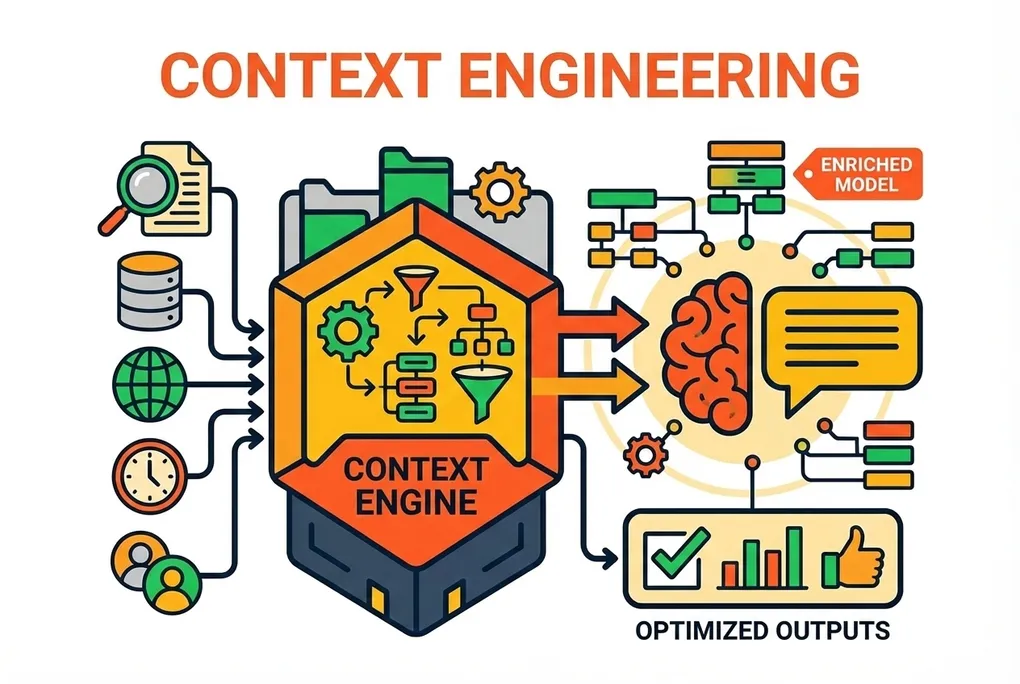
Context Engineering is the process of selecting, structuring, and optimizing information that is sent to a language model in its context window (its “short-term memory”).
If we compare AI to a brilliant expert, then context is everything on their desk at any given second. Context Engineering is not just about providing documents on that desk, but primarily about:
- Selecting the most important documents.
- Removing unnecessary “information garbage.”
- Adding instructions on how this specific data should be interpreted.
Why is Context Engineering Used?
The main goal is to maximize answer accuracy while limiting errors. An AI model has limited "attention" – the more irrelevant data we give it, the greater the chance it will miss a key fact or start hallucinating (making things up). We use it to:
- Increase precision: AI focuses only on facts relevant to the problem.
- Maintain consistency: Ensuring that the model remembers previous agreements from the conversation.
- Reduce costs: Fewer unnecessary words (tokens) means lower bills when using paid AI models.
Advantages
- High quality answers: AI rarely loses the thread and better follows guidelines.
- Personalization: Allows you to customize the tone and knowledge of the model to a specific user without the need for costly model retraining (Fine-tuning).
- No hallucinations: A clearly defined context “anchors” the model in facts.
Disadvantages and Limitations
- Context window limit: Every model has a specific capacity of “desk” (tokens). We cannot dump everything there.
- “Lost in the Middle” Phenomenon: Research shows that AI models perform best with information at the beginning and end of context, sometimes ignoring the middle.
- Complexity: Requires designing systems that intelligently choose what matters at any given moment.
RAG vs Context Engineering – Key Differences
These concepts are often confused. RAG is a data delivery process, while Context Engineering is a process of presenting it to the model.
| Feature | Retrieval Augmented Generation (RAG) | Context Engineering |
|---|---|---|
| Main Goal | Finding appropriate information in a large database. | Optimal arrangement and formatting of that information for AI. |
| Operation | Extracts e.g. 5 matching paragraphs from a 1000-page instruction manual. | Decides whether to present these 5 paragraphs as bullet points or as a quote, and what to add alongside. |
| Analogy | A librarian who brings you the right books from the archive. | An editor who prepares a short and clear note from those books. |
| When to Apply? | When you want to provide all data to the model (e.g., PDF files, customer database). | When you want the model to make better use of only your selected data. |
Practical Examples of Application
Example 1: Intelligent Customer Support Assistant
Instead of sending the AI the entire conversation history with the customer (which could overwhelm it), Context Engineering selects only the last 3 questions, current order status, and a brief summary of previous issues. Thanks to this, AI knows who it’s talking to but doesn’t get lost in details from a year ago.
Example 2: Programmer’s Assistant (AI Coding)
While writing code, Context Engineering analyzes which file the programmer is working in and automatically “suggests” to the model only the definitions of functions currently in use, instead of sending the entire application source code.
Example 3: Analysis of Legal Documents
When analyzing a contract, Context Engineering can involve providing AI with the contract text along with a “checklist” of prohibited clauses. The model doesn’t just read the contract but has imposed context: “look specifically for these errors.”
Summary
Context Engineering is the art of selection. In a world where there is more and more data, the key to success is not giving AI everything we know, but giving it exactly what it needs at any given millisecond.
Good Context Engineering makes artificial intelligence stop being just a “search engine” and become a partner that truly understands the situation you’re in.