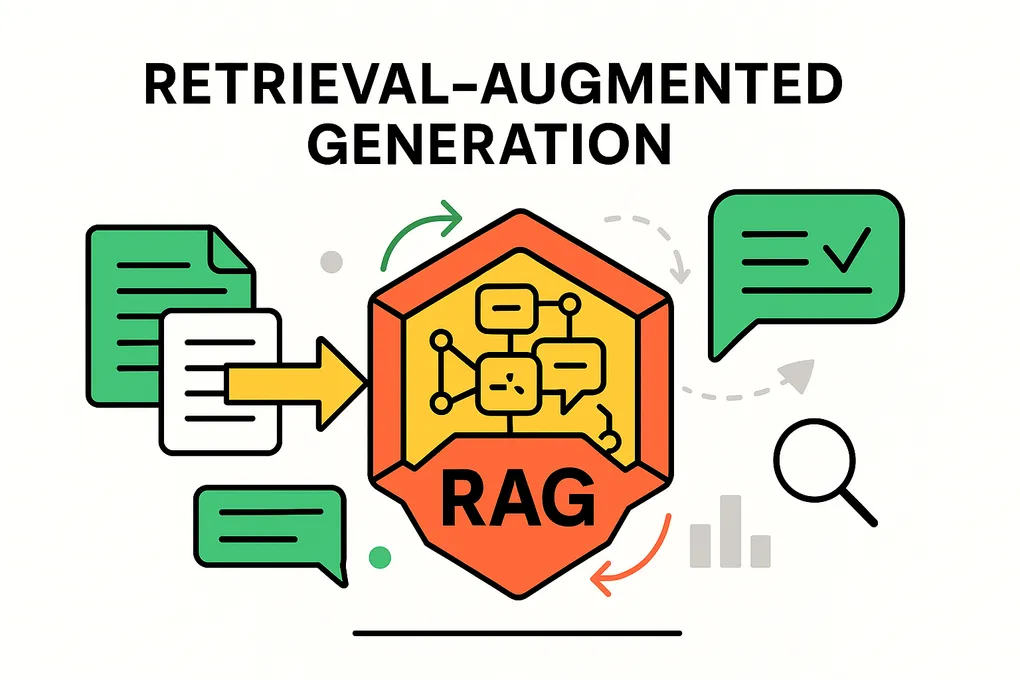
Retrieval-Augmented Generation (RAG): Connecting AI with External Knowledge
What is RAG?
Retrieval-Augmented Generation (RAG) is a technique that allows AI models to use external sources of information when generating answers. Imagine talking to an expert who checks facts in a trusted encyclopedia during the conversation – that’s exactly what RAG does.
Large Language Models (LLMs) are trained on huge amounts of text available on the internet, in books, and in articles – but only up to a certain point in time. For example, a model trained on data up to 2023 will not know about events from 2024 unless it is retrained. Moreover, these models learn from general data and may not have specialized knowledge from your industry or organization.
In practice, when you ask a question to a system using RAG, the system first searches through a knowledge base (documents, websites, databases), finds relevant information, and then uses it to formulate an answer. This combines the advantages of a search engine (access to current and specific information) with the capabilities of a language model (understanding the question and creating coherent answers).
Hallucinations – When AI “Makes Up” Facts
One of the biggest challenges associated with language models is their tendency to “hallucinate” – generate convincing-sounding but false or inaccurate information.
This happens when a model:
- Lacks needed knowledge but tries to answer anyway
- Incorrectly combines fragments of information from its training
- Misinterprets a question or context
Hallucinations are particularly problematic in applications where accuracy is critical – in medicine, law, finance, or education. Imagine a medical assistant that confidently provides incorrect drug dosages, or a legal assistant that cites non-existent laws – the consequences could be serious.
RAG as a Solution to the Hallucination Problem
And this is where RAG emerges as a solution. Instead of relying solely on knowledge gained during training, the model can verify facts in trusted sources before providing an answer. It’s like the difference between asking a random person on the street and consulting with an expert who checks information in reliable sources before answering.
Thanks to RAG:
- The model has access to current information, even if it was created after its training
- Answers are anchored in specific sources, which reduces the risk of making up facts
- The system can explain where the information comes from, showing fragments of source documents
Building Trust Through RAG
In the age of misinformation and fake news, trust in AI systems is crucial. RAG builds this trust by:
- Transparency: the system can show which sources it used
- Verifiability: users can check the sources of information
- Currency: answers are based on the most recent available information
- Error reduction: significant reduction in the number of hallucinations compared to standard models
Research shows that users are more likely to trust and use AI systems that can justify their answers with concrete sources than those that simply generate answers without references.
Where Does RAG Get Information From?
A RAG system can retrieve data from various sources:
- External APIs and services:
- Search engines (Google, Bing)
- Online encyclopedias (Wikipedia)
- Scientific databases (PubMed, arXiv)
- News services (Reuters, Bloomberg)
- Documentation platforms (GitHub, Stack Overflow)
- Weather and financial services (AccuWeather, Yahoo Finance)
- Organization’s own data:
- Internal documents (reports, instructions, procedures)
- Knowledge bases and company wikis
- Email archives and communications
- Customer and product databases
- Technical documentation and specifications
- Transcripts of meetings and interviews
RAG’s flexibility allows combining different sources, creating a system that has both broad general knowledge and deep understanding of information specific to your organization.
Advantages of RAG
- Current knowledge: The system can use the most up-to-date information, even if it wasn’t available during model training
- Accuracy: Answers are based on specific sources, which reduces the risk of hallucinations (making up facts)
- Transparency: The system can provide sources it used when creating the answer
- Specialized knowledge: The ability to add your own documents allows for getting answers in narrow, specialized fields
- Personalization: The knowledge base can contain documents specific to the organization, allowing for customizing answers to specific needs
Disadvantages and Limitations
- Implementation complexity: Requires creating and maintaining additional infrastructure for storing and searching documents
- Dependence on knowledge base quality: If documents in the database contain errors or are outdated, answers will also be inaccurate
- Limited creativity: The system may overly rely on literally quoting sources at the expense of synthesis and creative information processing
- Response time: Searching and processing documents can extend the time to get an answer
- Interpretation problems: The system may have difficulty selecting the most important information or interpreting conflicting sources
Practical Examples of Application
Example 1: Legal Assistant
A law firm creates a RAG system that has access to a database of regulations, precedents, and legal commentaries. Lawyers can ask it questions like: “What are the latest Supreme Court rulings regarding personal data protection in the context of internet marketing?” The system searches for relevant documents and presents a summary, saving lawyers hours of work.
Example 2: Customer Service Assistant
A company creates a chatbot using RAG that has access to a knowledge base about products, FAQ, and history of problems reported by customers. When a customer asks: “How do I fix a 404 error in the mobile app?”, the system finds the appropriate instructions and presents the solution in an accessible way.
Example 3: Scientific Research
A scientist uses a RAG system that searches scientific articles. Asking: “What are the latest discoveries in using mRNA in cancer vaccines?”, they get an answer based on the latest publications, along with references to specific studies.
Costs and Requirements
Memory: Requires significant memory to store the knowledge base – from several hundred megabytes to many terabytes, depending on the subject scope.
Infrastructure:
Additional components are needed:
- A database or vector system for storing and searching documents
- An indexing system that transforms documents into a format enabling fast searching
- A mechanism that determines the similarity between a question and documents
Financial Costs:
- Data storage costs (servers or cloud services)
- Processing costs (searching, generating answers)
- AI model API costs
- Potential licensing costs for access to specialized knowledge bases
Limitations Related to LLM Models:
- Limited context length (model may not be able to process all found documents)
- Difficulties with integrating conflicting information from various sources
- Possibility of incorrect interpretation or omission of important information
Summary
RAG is an effective solution when you need reliable answers based on concrete sources or when you want the model to have access to specialized knowledge or current information. However, it requires more resources and technical skills than prompt engineering alone.